247 Dizengoff. Old North.
On the northern stretch of Dizengoff, past the square, toward the port. Thirty-three residences, reinforcement and extension, held for the long-term owner.
The building
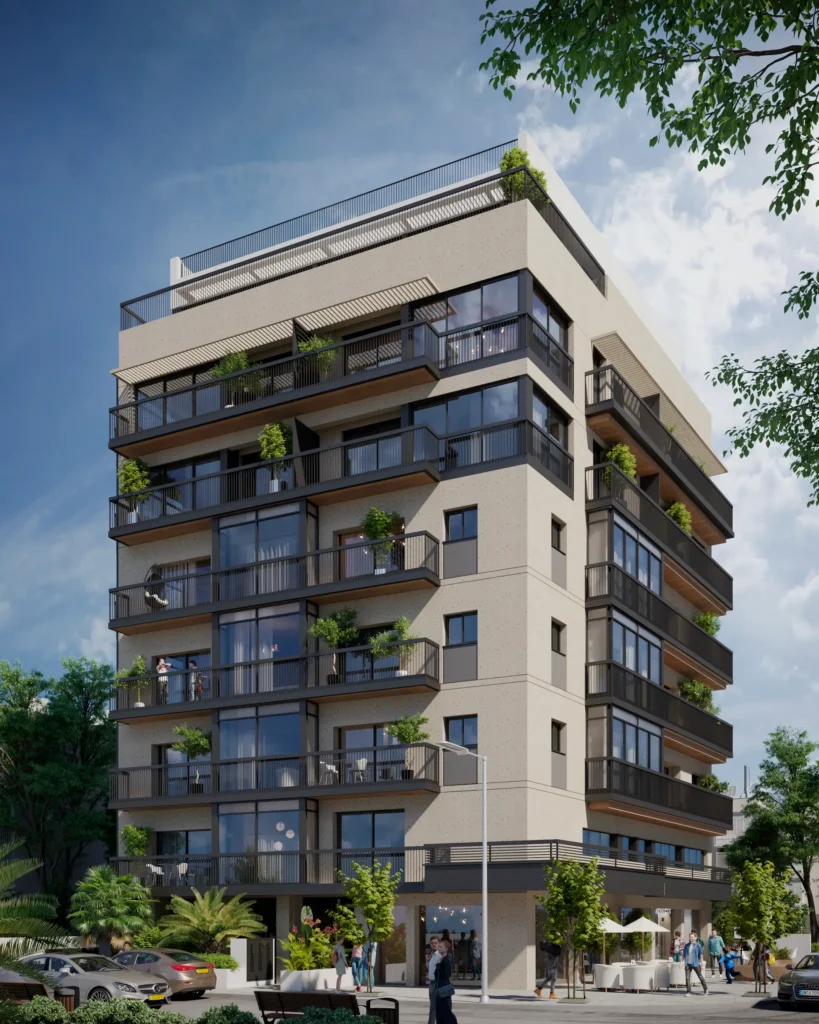
Eight storeys. Thirty-three residences. Architect Yiftach Arad. A TAMA 38/1 reinforcement and extension scheme — the existing five-storey building retained, structurally brought to current earthquake code, with three new storeys added above in contemporary line.
Post-committee decision. The scheme is in its permit-application phase. Construction commencement and handover dates follow the conclusion of the final permit cycle.
The street
Dizengoff is the street every returning Israeli remembers. It was built during the 1920s, described in its prime as the Champs-Élysées of Tel Aviv, and generated its own verb — l’hizdangef, “to Dizengoff oneself,” meaning simply to walk along it, be seen, stop for a coffee, encounter an acquaintance. For a full generation of the city’s residents, Dizengoff was the Tel Aviv of which everywhere else was a suburb.
The street had a difficult three decades from the 1970s through the 2000s, and the memory of that period is still what many older residents carry when the name is mentioned. The restoration has been quiet but substantial. The northern stretch of Dizengoff — the section in which number 247 sits — has recovered into one of the city’s most legible residential-and-commercial mixed-use corridors, with the Israeli designer fashion houses, the independent bookshops, and the small neighbourhood cafés that characterised the street’s original register now meaningfully back at their addresses.
The position
Number 247 sits on the upper stretch of Dizengoff, past Dizengoff Square and north of the intersection with Nordau Boulevard. The building is in the quarter traditionally called the Old North — specifically, the Tel Nordau section — rather than in Lev Ha’ir further south. This distinction matters: it is the residential Dizengoff rather than the commercial Dizengoff, close enough to the street’s cultural density to inherit it, far enough north to be quiet in the evenings.
A specific walking-distance register worth noting: the Tel Aviv Port and its promenade are a six-minute walk west. The Yarkon Park begins a nine-minute walk north. Frishman Beach is eight minutes west through the cross-streets. Gordon Beach, with its long-established café-and-gallery stretch, is five minutes. Rabin Square and the cultural centre of the city are twelve minutes south. Dizengoff Square itself is six minutes along the street.
The position gives a resident both the cultural density of central Dizengoff and the quieter residential character of the Old North — an unusual combination in a single address.
The building’s scale and register
Thirty-three residences is the largest of the Ben Shalom buildings under representation. At this scale, the building operates differently from the boutique Lev Ha’ir buildings (11 to 16 residences) or the family-scale Bavli buildings (20 to 22 residences). It is large enough to sustain a proper lobby with attended presence, a gym, and shared amenity space that the smaller buildings cannot provide. It is small enough to remain a residential address rather than a mass-market development.
The address is best understood as Ben Shalom’s mid-scale offering — a proper building with amenities, held in the register of an established residential address on one of the city’s most recognised streets.
The buyer
247 Dizengoff is addressed to a specific set of buyers:
Returning Israelis who remember Dizengoff Street in its original register and want to live on the street itself. Senior residents who want the cultural density of central Tel Aviv without the compact scale of a Lev Ha’ir boutique building. International buyers whose European reference point is an immeuble on the Rue du Faubourg Saint-Honoré or a building on Marylebone High Street — a proper building on a proper street, rather than a side-street residence — and who accept that their address will be read as such when they share it.
The building is not the right register for an investor looking for short-let yield (the building’s own admission policy, the va’ad bayit character, and the demographic of thirty-three residents all work against that intention). It is the right register for a buyer who wants a substantial primary residence on a street they themselves remember.
The representation
The scheme is in its permit application phase. Once the final permit is granted, the developer will release an initial set of residences for qualified enquirers ahead of a broader marketing phase. Handover is anticipated in 2028 or shortly thereafter, allowing a buyer committing in the current period a meaningful lead time.
For buyers who introduce themselves to the office at this stage of release, the full inventory — including the upper-floor residences on the newly-added three storeys, with the clearest aspect along the Dizengoff axis — remains under discussion rather than on the public portal.
On the street every returning Israeli remembers. A proper building, on its northern and quieter stretch. Not Lev Ha’ir, not Bavli — the Old North of Dizengoff itself.
A note from the office. If you are considering 247 Dizengoff — or if your register is the Dizengoff axis specifically — a brief conversation is the simplest place to begin.
→ Request a conversation
By appointment. By introduction. By conversation.