
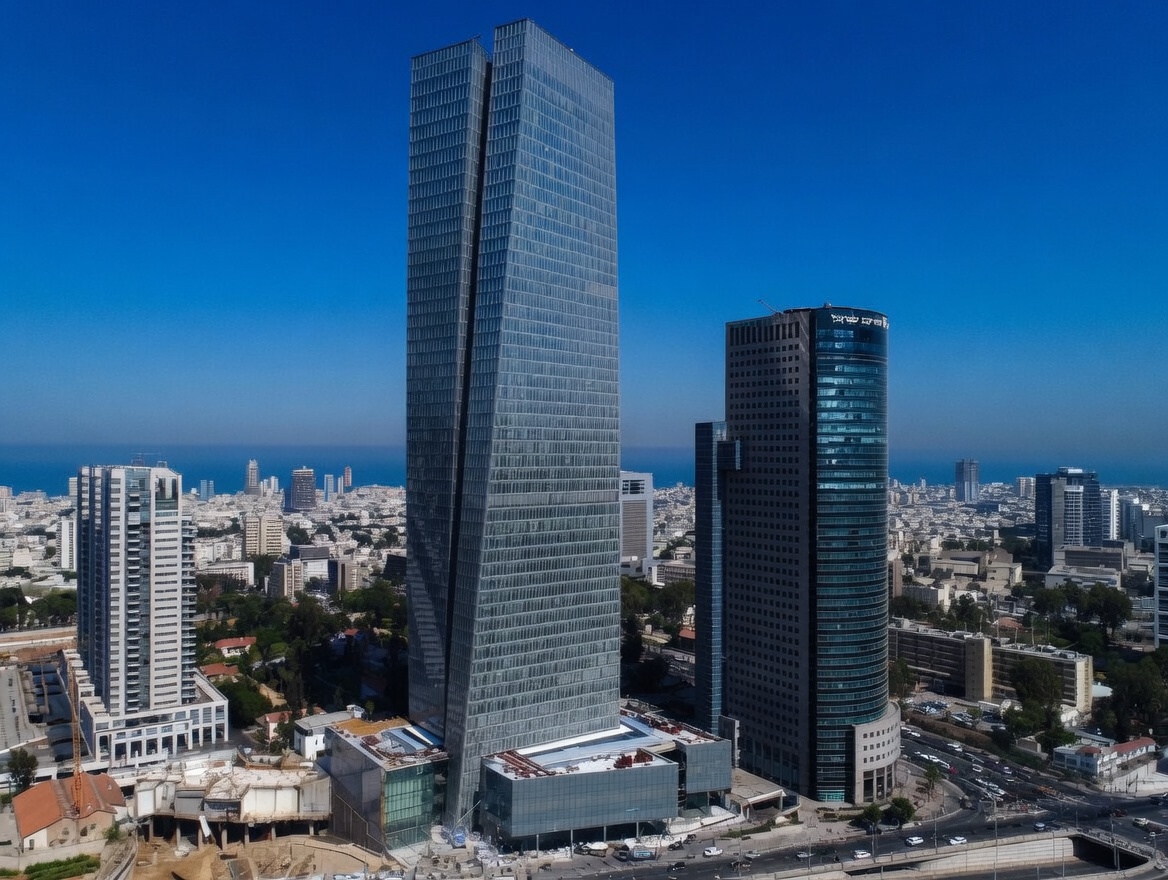
Above the restored Templer colony. Tel Aviv’s closest answer to Manhattan’s mixed-use model.
Sarona · Central Tel Aviv
The Sarona quarter represents the most significant urban regeneration project in contemporary Tel Aviv. A nineteenth-century German Templer colony — founded in the 1870s by a small religious community who built stone farmhouses, planted vineyards, and laid out streets that remain, in their original grid, legible today — has been restored and integrated with a new commercial district rising around it. The preserved Templer buildings house the city’s principal gourmet food destination at ground level. The contemporary towers above them provide office and residential space at a density and specification unfamiliar in Tel Aviv before the last decade.
Sarona Residences is the high-end residential component of this integration. The building occupies the upper floors of the development, placing residents above the restored colony and the Sarona Market, with direct lift access to both.
On the quarter
Sarona is the central commercial heart of contemporary Tel Aviv, and increasingly its most sophisticated dining and retail environment.
The Sarona Market food hall is the city’s principal gourmet destination. The restored Templer houses contain the highest concentration of chef-led restaurants outside Neve Tzedek. The Azrieli office and shopping complex — which includes Israel’s tallest completed building — sits immediately adjacent. The HaShalom railway station, the Kaplan government district, the Yitzhak Rabin Centre, and the Tel Aviv Museum of Art anchor the wider quarter to the west. The transport infrastructure — rail, highway, the planned light rail — is among the strongest in the country.
For a resident whose daily life is concentrated in the central commercial axis, Sarona is the address that collapses the distance between residence, office, and cultural infrastructure to walking scale.
On the buyer
Sarona attracts the buyer whose life is already in the quarter.
Senior technology executives working in the adjacent office cluster. Finance professionals in the Azrieli complex. Corporate relocators arriving through one of the international firms with a Tel Aviv development office. The resident profile is young by the standards of the city’s top register, and international in composition — Anglo, French, and East Asian contingents are all meaningfully represented.
The view down upon the restored Templer colony — available from no other residential building in the city — is frequently cited by residents as one of the decisive features of the purchase. A view of old stone, mature trees, and a nineteenth-century village grid, framed at close range and from above, is the kind of residential amenity that cannot be engineered into a newer context.
On representation
Sarona Residences produce steady inventory for a primary-residence tower of its scale.
Corporate relocations conclude. Families reach school ages that take them to more family-oriented quarters. Senior executives retire and consolidate. These are the ordinary life-circumstance movements of a professional residential community, and they produce residences at a predictable pace.
We have handled introductions at Sarona Residences on multiple occasions, most often to corporate relocators arriving in the city for the first time and to senior technology and finance executives whose working lives were already concentrated in the quarter. For this profile of buyer, the building is frequently the correct answer without a close second.
Above the old Templer colony, in the new central commercial quarter. The view the city’s skyline itself cannot deliver.
A note from the office. If you are considering a residence at Sarona — as a buyer, as an owner, or simply as a matter under quiet consideration — a brief conversation is the simplest place to begin.
→ Request a conversation
By appointment. By introduction. By conversation.


