
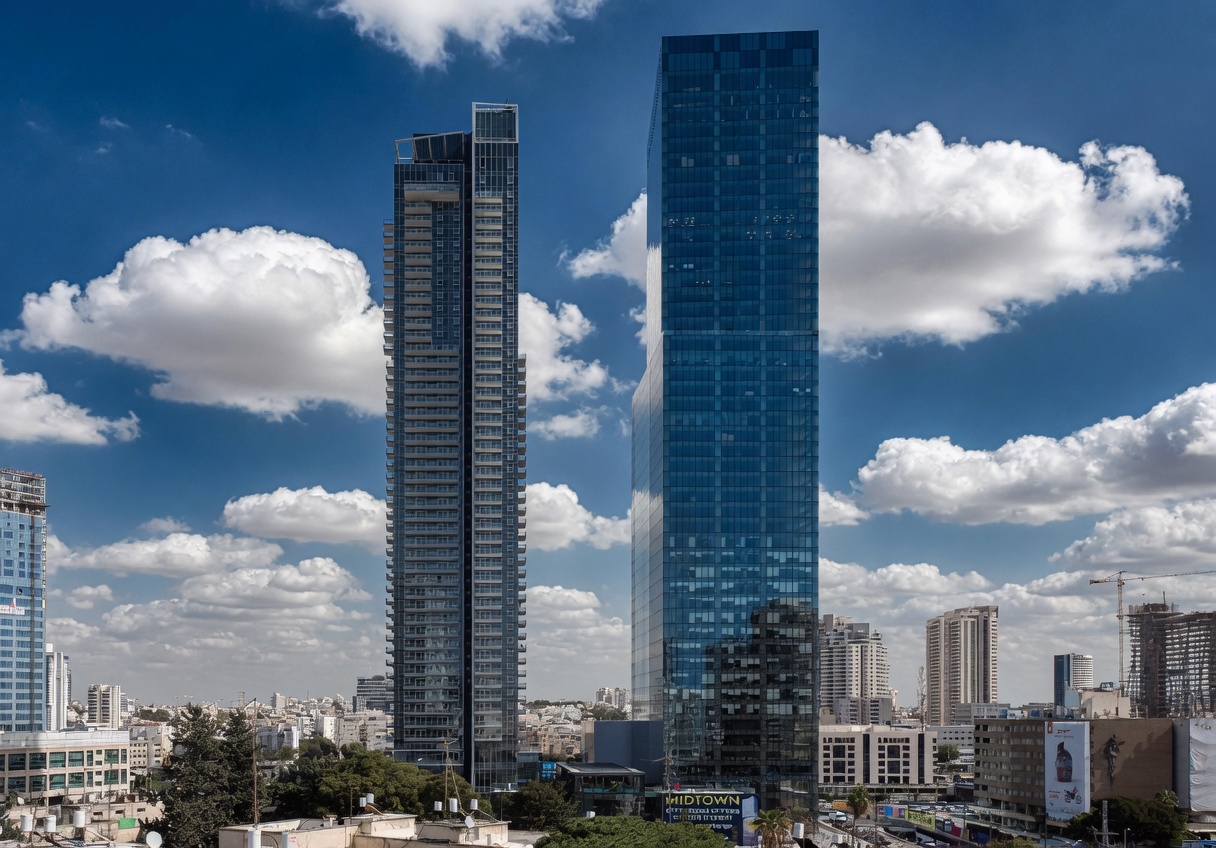
Midtown Residential Tower
Fifty floors above the Sarona axis. Tel Aviv’s clearest answer to the Manhattan high-rise.
Midtown · Central Tel Aviv · Completed 2018
Every city that has grown into its own modern identity produces, at some point, a residential tower that does not apologise for its height. In New York, this was the arrival of the Midtown residential cluster in the 1980s. In London, Canary Wharf and, more recently, the City fringes. In Tel Aviv — a city that arrived at serious vertical development considerably later than its peers — the Midtown Residential Tower is the clearest example of the type.
One hundred and eighty-three metres, fifty floors, three hundred and thirty-eight residences. The building is unambiguously a high-rise in the American sense — a scale, density, and operational model closer to the downtown residential tower of lower Manhattan or central Chicago than to anything the city had previously attempted at this register.
On the quarter
Midtown is the commercial heart of contemporary Tel Aviv.
The Sarona district, anchored by the restored nineteenth-century Templer colony and the Sarona Market food hall, sits at the building’s doorstep. The Azrieli Center complex — offices, retail, the country’s tallest completed tower — is adjacent. The Kaplan Street government quarter extends to the west. The HaShalom railway station places the national rail network at the base of the building, with direct services to Jerusalem, Ben Gurion Airport, and Haifa. The tower sits at the national commercial axis in a way that few residential addresses, anywhere in the country, can claim.
The weekday atmosphere is corporate in the best sense. Weekend activity is residential and unhurried.
On the buyer
Midtown attracts a younger and more professional resident profile than the city’s other luxury towers.
Senior executives in the technology and financial sectors are disproportionately represented. Many residents work in the Azrieli office cluster, or in the Sarona commercial axis immediately adjacent, and have chosen the building specifically to eliminate the commute. A significant Anglo contingent has arrived via senior corporate relocation — often through one of the international technology firms with a Tel Aviv development office, often for an initial tenancy of three to five years that has, in many cases, extended into acquisition.
The international share is meaningful but differently composed from the coastline buildings. Where the David Promenade and Royal Beach attract secondary-residence buyers, Midtown attracts primary-residence owners who have relocated to Tel Aviv for professional reasons. The residences are lived in, fully, for most of the year.
On representation
Midtown produces a steadier flow of resale inventory than the city’s older luxury buildings.
Corporate relocations conclude. Families reach school ages that take them out of the district. Couples upgrade to larger residences within the building or relocate to family-oriented addresses further north. These are the ordinary patterns of a primary-residence community, and they produce inventory at a pace the older buildings do not match.
We have handled introductions at Midtown on multiple occasions, often to corporate relocators arriving in the city for the first time and to returning Israelis whose professional lives are concentrated in the central commercial axis. For this profile of buyer, the building is frequently the correct answer without much further discussion.
The closest Tel Aviv equivalent to the American downtown residence. Lived in, by professionals who live where they work.
A note from the office. If you are considering a residence at Midtown — as a buyer, as an owner, or simply as a matter under quiet consideration — a brief conversation is the simplest place to begin.
→ Request a conversation
By appointment. By introduction. By conversation.


